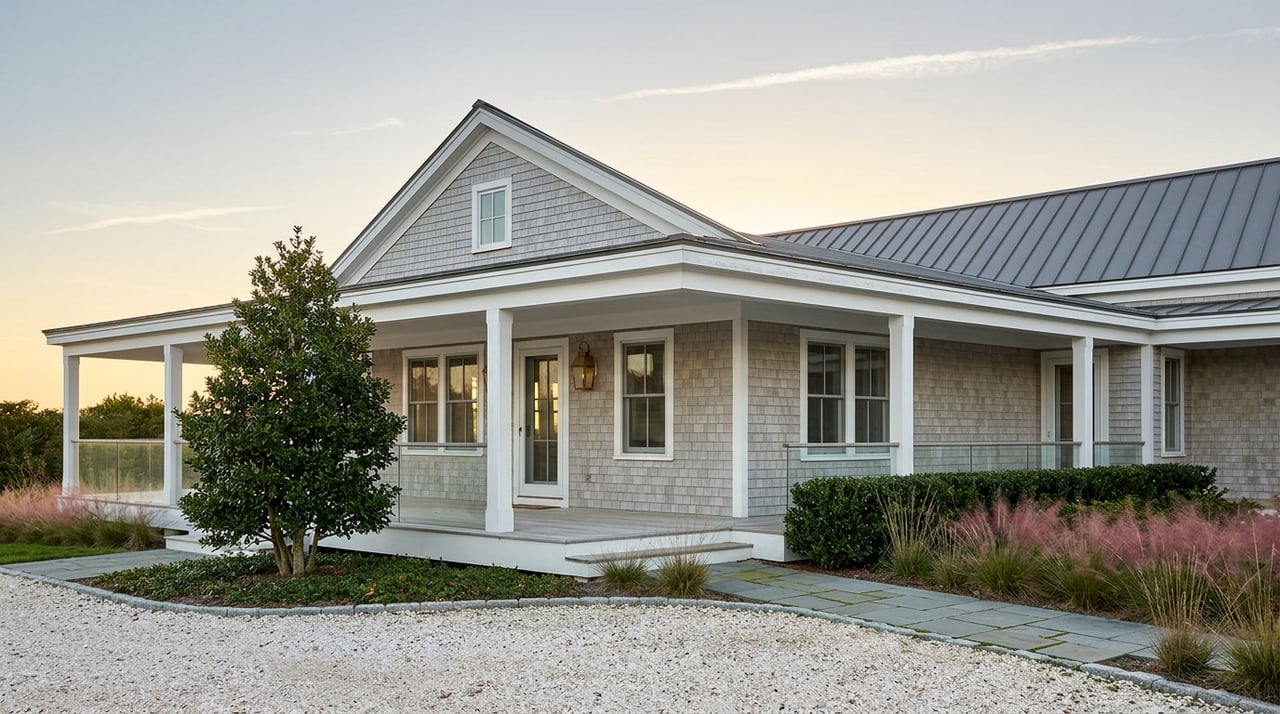
Stand on the sand just south of the Bethany Beach boardwalk and look both directions. To the north, low shingle-style cottages and small inns rise no higher than a few stories, tucked behind dune grass and picket fences. To the south, nine high-rise towers climb well above anything else on this stretch of coast, part of the Sea Colony resort. Both are sold to buyers as Bethany Beach real estate. Both use the same zip code, 19930. Only one of them sits inside the actual Town of Bethany Beach.
That line, drawn on a zoning map most buyers never ask to see, decides more than which mailbox you get. It decides your property tax bill, whether a short-term rental keeps 93 percent of its nightly rate or gives up 11.5 percent of it, whether you're eligible for a free parking hangtag each summer, and why one side of that invisible boundary was allowed to rise into high-rise towers while the other side still argues over whether a roof can hit 35 feet.
Why the Skyline Splits at a Line You Can't See
Sea Colony's towers exist because of where they're not. When developers proposed the beach and tennis resort in 1969, longtime Bethany Beach residents pushed back hard, worried about high-rises and crowds changing the character of their town. They marched, filed legal challenges, and tried to stop construction. They lost, not because the town's rules allowed it, but because the land the towers would sit on had never been inside those rules to begin with. Bethany Beach's own zoning had been built specifically to keep high-rises out of town, and Sea Colony's site sat outside the boundary that zoning could reach.
The resort went on to become one of the most successful developments on the Delaware coast, eventually adding a 1,200-unit low-rise expansion called Sea Colony West just inland from the original towers. None of it required Bethany Beach's approval, because none of it was in Bethany Beach.
That history isn't a one-time quirk from the 1970s. The town has kept tightening its own height rules for decades since, and the fights have stayed local and specific. In 2020, a Bethany Beach resident led a petition drive to repeal a new ordinance that let single-family homes in the R-1 district reach 35 feet with a steeper roof pitch. The town's own building inspector had to publicly clarify that the change amounted to a few feet in practice, not the four-foot jump critics claimed, because height in Bethany Beach is measured from base flood elevation rather than street grade, and that measurement point moves depending on where a lot sits in the flood plain. The debate never got a formal binding vote, but it showed a town still actively defending a low-rise skyline nearly fifty years after Sea Colony proved what happens once you step outside its reach.
The Tax Bill Follows the Boundary, Not the Zip Code
Every property inside the incorporated Town of Bethany Beach pays a municipal property tax on top of the county rate. Every property outside it, including Sea Colony just south of the town's boundary, pays the county rate alone.
For fiscal year 2027, which began this April and runs through next March, the Bethany Beach Town Council approved a 6 percent property tax increase, its first rate change in at least two years. Town officials tied the increase to rising costs for public safety, including expanded police coverage at Bandstand events, seasonal lifeguard hiring, and new surveillance equipment. Town estimates put the typical increase at about $96 a year for most property owners.
A flat rate doesn't always mean a flat bill, though. Sussex County completed a countywide property reassessment in 2025 that reset assessed values across the board, which is part of why a homeowner's total tax bill can jump even in a year when the municipal rate itself doesn't move. That reassessment affected every property in the county, inside town limits or not, but only properties inside Bethany Beach's boundary carry the municipal layer on top of it. A buyer comparing two nearly identical homes, one addressed in town and one addressed just outside it, is really comparing one tax bill built from two layers against one built from a single layer.
| Inside Bethany Beach town limits | Outside, in unincorporated Sussex County | |
|---|---|---|
| Property tax | County rate plus town rate ($2.07 per $100 assessed value baseline, up 6% for FY2027) | County rate only |
| Short-term rental tax | 7% town rental tax plus required license, on top of the state's 4.5% lodging tax | State's 4.5% lodging tax only, no local add-on currently in effect |
| Resident parking permit | Free permit for owners of improved property, plus optional paid upgrades | Not eligible, regardless of address |
| Historic building height | Height limits actively debated and enforced since at least the 1970s | No town height ceiling to navigate |
What the Line Does to a Short-Term Rental's Bottom Line
For anyone weighing a coastal property as a rental investment, the boundary shows up directly on the income statement. A short-term rental inside Bethany Beach owes the town a 7 percent rental tax on gross receipts, in addition to Delaware's statewide 4.5 percent short-term lodging tax, and the property has to carry a town rental license to operate legally at all. That's an 11.5 percent combined tax load on every dollar of rent collected.
A comparable property just outside the town line, addressed the same way but sitting in unincorporated Sussex County, currently owes only the state's 4.5 percent lodging tax. Sussex County considered adding its own 3 percent county-level lodging tax on unincorporated short-term rentals, but that proposal was defeated at a December 2024 county council hearing. Unless the county revisits it, an unincorporated rental keeps roughly 7 percentage points more of its gross rent than an identical property a few hundred feet away, inside the line.
That gap doesn't make one location better than the other for every buyer. It does mean the math on a rental pro forma changes depending on which side of an unmarked boundary the parcel sits on, and that boundary rarely shows up in a listing description.
The Permit You Cannot Buy With a Bigger Down Payment
Bethany Beach offers property owners a free Resident Parking Permit for their improved property, with the option to buy a $50 Side Street Permit or a $200 Sand and Side Street Permit that adds access to beach parking lots east of Atlantic Avenue during the paid season. To qualify for any of it, the town's own rules are explicit: you have to reside within the incorporated town limits, verified against the official zoning map.
Owners just outside that line don't get the option at any price. What they typically get instead is a different kind of amenity entirely. Sea Colony owners have access to a half-mile of private beachfront, private pools, and a tram system reserved for owners and guests, an arrangement that trades a municipal resident perk for a resort-style private one. Neither option is objectively better. They're just different systems, and a buyer who assumes "Bethany Beach" means the same parking experience everywhere is going to be surprised standing in a pay-to-park line in July.
How to Find Out Which Side You're On
None of this shows up by squinting at a listing photo or a zip code. The only reliable way to know which system applies to a specific parcel is to check it against the Town of Bethany Beach's official zoning map before writing an offer, not after closing. The town's building and parking departments both reference that map directly when determining eligibility for permits and building rules, and it settles the question in a way a listing description never will.
If you're comparing properties along this stretch of coast, whether you're weighing a rental's real return, budgeting for a tax bill five years out, or just wondering whether you'll need quarters for the meter every summer, the boundary is the first thing worth asking about, not the last. It has shaped this coastline's skyline for fifty years and it's still writing the budget today.
If you want a second set of eyes on where a specific address actually falls before you make an offer, Betsy Perry has spent years working this exact stretch of the Delaware coast, line by line. Let's talk about your next coastal move.