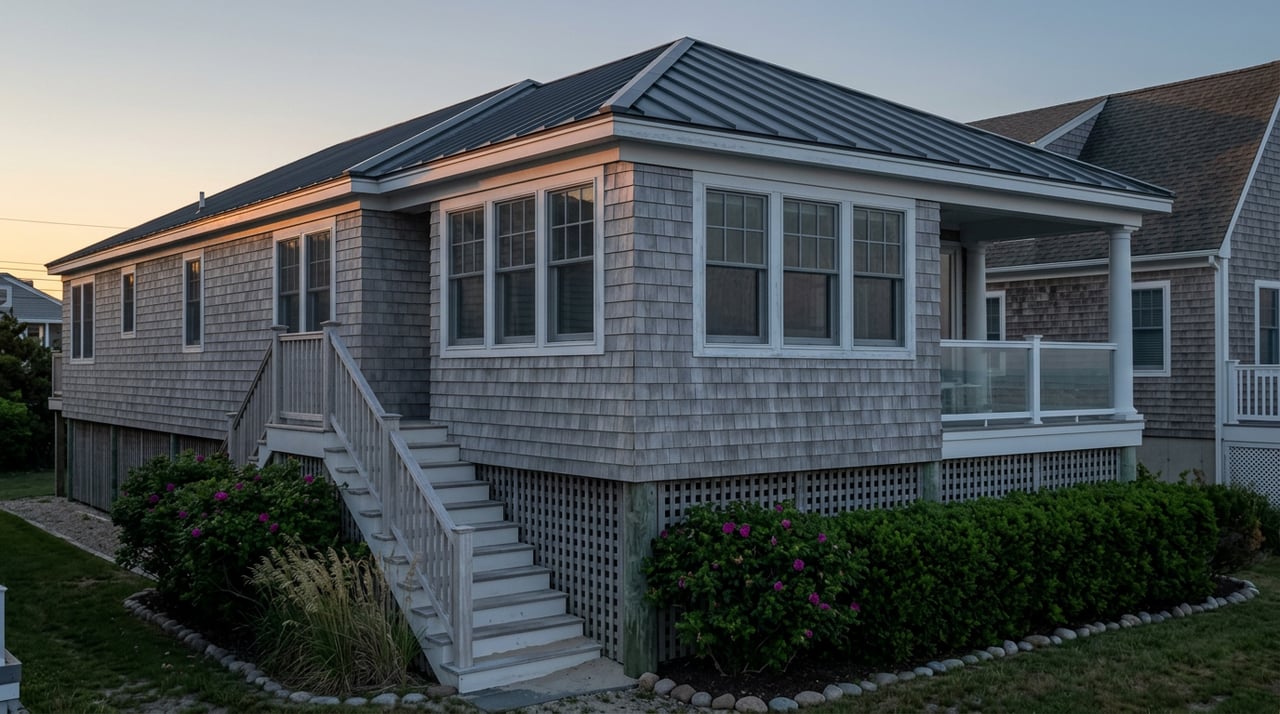
Right now, if you want to buy a brand-new home on the ocean side of Fenwick Island, you have exactly one option. A nearly 4,700-square-foot custom build on Maryland Avenue, priced at $4.9 million, two homes back from the beach, not expected to be finished until early 2027.
That single listing wasn't a marketing flourish. It was a fact about supply. In a town built on a narrow strip of sand between the Atlantic and Little Assawoman Bay, the buildable lots ran out well before the demand did, and what's left of them is quietly splitting Fenwick Island into two markets that get reported as one number.
The Number That Isn't There
Search for new construction in Fenwick Island right now and the results are thin to the point of being a statement in themselves. The Maryland Avenue property stood out precisely because there was nothing else like it on the market. Most of what buyers actually find is older housing stock, priced to reflect either its current condition or its potential after a full renovation or teardown.
That matters if you're relocating from a market where new construction is the default path to getting exactly what you want. Here, it isn't a path most buyers get to choose. It's a listing you wait for, and when it appears, it prices itself against nothing comparable, because there's nothing comparable to price it against.
Why the Lots Ran Out
Fenwick Island's zoning code caps building height at 30 feet townwide, and layers setback and lot coverage rules on top of that, which together determine how much house actually fits on any given parcel. Those rules read as routine on paper. On the ground, in a town this narrow, they mean a bayside canal lot and an oceanside lot can support very different footprints, and neither one supports much more building than what's already there.
The geography compounds it. A barrier spit only has so much land, and Fenwick Island incorporated in 1953 specifically to stay a quiet, low-density oceanfront town rather than grow into something denser. Decades later, that choice shows up as a market where the physical inventory of raw, buildable lots is close to exhausted, and the height and coverage limits mean even a teardown doesn't necessarily buy you a bigger house, just a newer one on the same footprint.
The Council Legislated Around Its Own Scarcity
In 2022, the Town Council didn't fight that scarcity. It planned around it. A zoning amendment created a new category called "Historic Residence," defined as a single-family home built before 1967 with recognized historic significance to the town. The change lets owners of those homes renovate and repair them under the town manager's discretion, as long as the work preserves the home's original size, dimensions, and footprint.
The council was direct about why. As the Coastal Point reported at the time of the vote, council member Richard Benn said the change would help:
"preserve what's left of the historic nature of Fenwick Island."
What's left. Not what exists. The town's own 2017 comprehensive plan had already flagged that its stock of historic cottages was down to a handful, and this amendment was the legislative response, not a symbolic one.
Two Products, One Median Price
Put the pieces together and Fenwick Island's median list price is really an average of two products that don't behave the same way.
| Buying New | Buying to Renovate | |
|---|---|---|
| What you're paying for | One of the last buildable envelopes in town, already built out | An existing footprint, plus the right to keep it |
| How you find it | Wait for a rare listing, or buy land and build over roughly 12 to 18 months | Close on what's available, renovate on your own schedule |
| How it's priced | One-of-one, with no direct comparable on the market | Priced against recent sales of similar vintage and condition |
| Main constraint | 30-foot height cap, setback and lot coverage limits | Historic Residence rules if pre-1967, current zoning otherwise |
A buyer comparing Fenwick Island to a nearby town on median price alone is comparing two different experiences without knowing it. One path is a bidding process for something that essentially doesn't repeat. The other is a much larger, faster-moving pool of renovation-ready homes competing against each other.
For buyers priced out of either tier, ocean-block condos and mid-rise units are the third option worth knowing about. They typically trade well below the large single-family oceanfront price point and can work as seasonal rentals depending on the building's own rules, which matters if rental income is part of the plan. Anyone weighing that path should also factor in Delaware's 4.5 percent state lodging tax, which has applied to short-term rental agreements entered into since January 1, 2025.
The Address Doesn't Always Mean What You Think
Not every property with a Fenwick Island mailing address sits inside the incorporated town. Areas like West Fenwick can fall under Sussex County zoning instead of the Town's, and that changes everything discussed above. The 30-foot cap, the Historic Residence carve-out, the town's setback table, none of it necessarily applies if a different authority governs the parcel.
The Town of Fenwick Island's own building department is explicit that its jurisdiction covers only land within town limits, and that anyone building outside that boundary needs to go through the Sussex County building inspection office instead. Before assuming what a lot allows, confirming which office actually has authority over it is the first call to make, not a formality to handle later.
What the Compressed Timeline Actually Signals
In July 2026, homes that sold in Fenwick Island moved in a median of 34 days, a 68 percent drop from the same month a year earlier. Read on its own, that looks like a town suddenly discovered. Read against everything above, it looks like something narrower: a shrinking supply of the specific kind of listing this market can produce, cleared faster because there's so little of it to clear.
There's no new-construction pipeline sitting behind the scenes to slow that pace down. Every renovation-ready home and every recently updated cottage is competing for the same tight band of demand, and when that's the entire available pool, it moves fast almost by definition.
FAQ
Can I still build a new home in Fenwick Island? Yes, if a buildable lot exists and the site can accommodate the town's 30-foot height cap along with its setback and lot coverage rules. The scarcity is in the lots, not in the right to build on them.
Does the Historic Residence rule apply automatically to any older home? No. It applies specifically to single-family homes built before 1967 with recognized historic significance to the town, and the exception only covers renovations that keep the home's original size, dimensions, and footprint intact.
How do I find out if my lot falls under Town or County rules? Start with the Town of Fenwick Island's building department. If the parcel is in an area like West Fenwick, Sussex County's building inspection office may be the actual governing authority.
If you're comparing Fenwick Island against other Delaware beach towns, the median price on a portal won't tell you which of these markets you're actually shopping in, or which rules apply to the specific lot you're looking at. That reading comes from tracking the town's zoning file, not just its listing sheet. Betsy Perry works this stretch of coastline block by block. Let's talk about your next coastal move.